THE SCIENCE BEHIND WOOSAHX

The science behind personalized mental training

Performance is not only about what you can do. It also depends on whether you can access those abilities when the moment demands it. WoosahX brings together principles from sport psychology, observational learning, emotional learning and immersive technology to support personalized mental preparation.

Performance begins when ability is available under pressure.

A closer look at the WoosahX method

The explainer video offers a concise introduction to the scientific background and central idea behind WoosahX. It shows how mental preparation, personal relevance and audiovisual content can form a focused training experience.

ABILITY UNDER PRESSURE

The best movement is the one you do not have to consciously control in the decisive moment.

Well-practised movements can be disrupted under pressure when athletes begin consciously controlling every individual step. Reinvestment theory describes a possible relationship between this conscious control and a decline in performance.

WoosahX therefore directs mental preparation toward relevant situations, clear cues and intended responses. Athletes can focus on the moments that matter in training and competition.

Masters & Maxwell (2008)

In the decisive moment, the goal is not to think more. It is to be prepared for what matters.

Combat athlete with wrapped hands and a focused gaze beside a boxing ring
Calm is not passivity. It is controlled readiness.

The scientific foundations

Six research-informed principles shape how WoosahX approaches personal mental preparation.

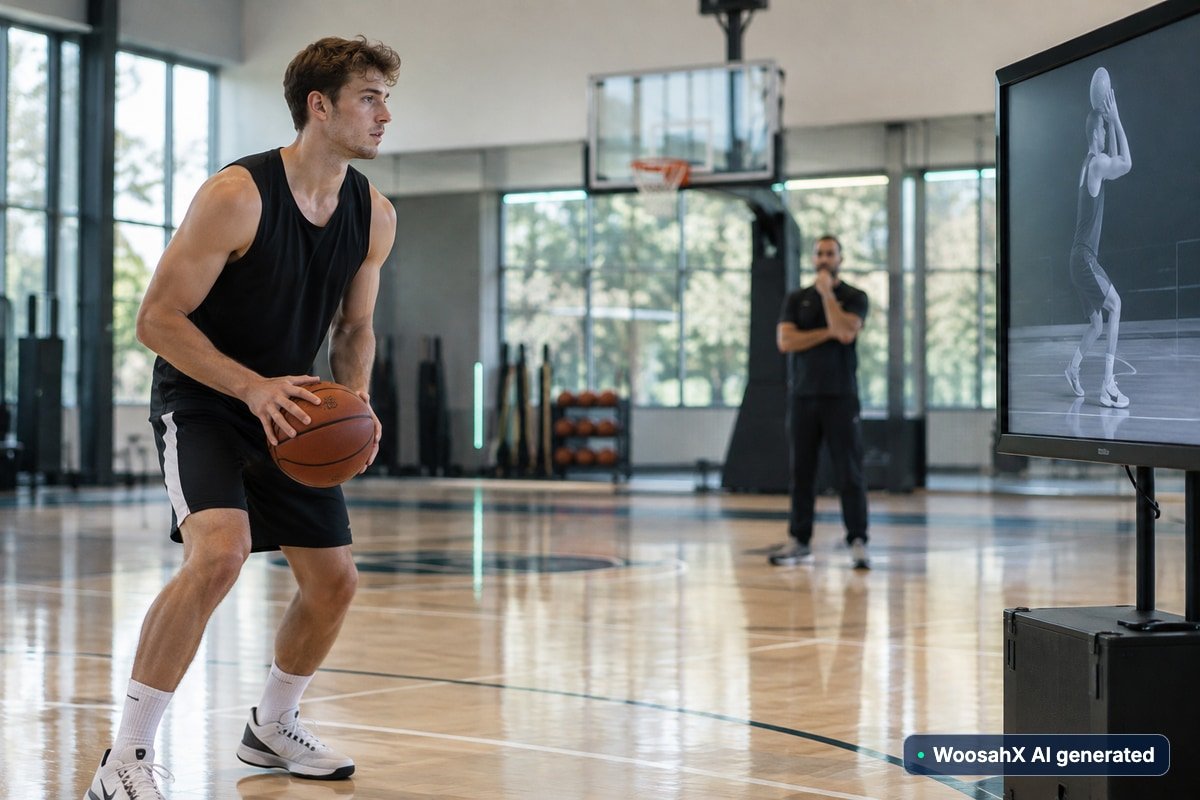
Basketball player holding a ball and watching a movement demonstration on a screen
See the action. Recognise what matters.
  1. Goals and attention

    Specific goals that an athlete accepts can help direct attention and effort.

    At WoosahX, a personal development focus gives mental preparation a clear direction.

    Review

    Locke & Latham (2006)

    DOI: 10.1111/j.1467-8721.2006.00449.x
  2. Observation and motor imagery

    Observing actions and imagining movements can complement physical practice.

    WoosahX uses this approach to support the mental preparation of movements, decision-making situations and relevant cues.

    Review

    Eaves et al. (2016)

    DOI: 10.3389/fnins.2016.00514
  3. Emotion and memory

    Emotion can shape attention and memory, depending on its intensity, context and relevance to the content.

    WoosahX therefore focuses on personal relevance and an athlete’s own sporting situations.

    Review

    Tyng et al. (2017)

    DOI: 10.3389/fpsyg.2017.01454
  4. Multimedia learning

    Related images, words and visual cues can support understanding when they are clearly coordinated.

    This research informs the clear structure of WoosahX audiovisual content.

    Meta-meta-analysis

    Noetel et al. (2022)

    DOI: 10.3102/00346543211052329
  5. Self-efficacy

    Self-efficacy describes the belief that a specific task can be managed successfully.

    WoosahX places personally relevant challenges and sporting goals at the centre of mental preparation.

    Meta-analysis

    Moritz et al. (2000)

    DOI: 10.1080/02701367.2000.10608908
  6. Repetition and familiarity

    Spaced repetition can support memory and familiarity.

    WoosahX applies this principle by returning to personally relevant content across multiple sessions.

    Meta-analysis

    Cepeda et al. (2006)

    DOI: 10.1037/0033-2909.132.3.354
Football player controlling the ball on the pitch in front of spectators
What you practise consistently becomes more familiar.

REPETITION

What you practise consistently becomes more familiar.

Repeated engagement with selected content can support memory and familiarity. WoosahX therefore integrates recurring mental preparation into the athlete’s personal training routine.

Research on distributed practice shows that the timing and spacing of repetition influence recall. WoosahX applies this principle by returning to personally relevant content across multiple sessions.

Cepeda et al. (2006)
Athlete sitting in an armchair with a VR headset in a stadium lounge
Less outside. More room for focus.

VR AS AN OPTION

Less outside. More room for focus.

With a VR headset, the WoosahX session appears on a large virtual screen. Visual distractions from the surrounding environment move into the background, creating a clearly defined viewing space.

Immersion can support a sense of presence and personal involvement. WoosahX therefore uses VR as a focused viewing format within personalised mental preparation.

Makransky & Petersen (2021)

How WoosahX translates research into practice

  1. Research-informed approach

    WoosahX draws on selected findings from sport psychology, learning research, action observation and immersive learning.

  2. Personal application

    These principles are aligned with each athlete’s goals, challenges and relevant sporting situations.

  3. Ongoing development

    Practical experience, user feedback and structured evaluation inform the continued development of WoosahX.

Selected studies and sources

The original publications behind the principles discussed here.

  1. Review

    Locke, E. A. & Latham, G. P. (2006)

    New Directions in Goal-Setting Theory

    Current Directions in Psychological Science

    DOI: 10.1111/j.1467-8721.2006.00449.x

    Read publication
  2. Review

    Eaves, D. L., Riach, M., Holmes, P. S. & Wright, D. J. (2016)

    Motor Imagery during Action Observation: A Brief Review of Evidence, Theory and Future Research Opportunities

    Frontiers in Neuroscience

    DOI: 10.3389/fnins.2016.00514

    Read publication
  3. Meta-meta-analysis

    Noetel, M., Griffith, S., Delaney, O., Harris, N. R., Sanders, T., Parker, P., del Pozo Cruz, B. & Lonsdale, C. (2022)

    Multimedia Design for Learning: An Overview of Reviews With Meta-Meta-Analysis

    Review of Educational Research

    DOI: 10.3102/00346543211052329

    Read publication
  4. Review

    Tyng, C. M., Amin, H. U., Saad, M. N. M. & Malik, A. S. (2017)

    The Influences of Emotion on Learning and Memory

    Frontiers in Psychology

    DOI: 10.3389/fpsyg.2017.01454

    Read publication
  5. Meta-analysis

    Cepeda, N. J., Pashler, H., Vul, E., Wixted, J. T. & Rohrer, D. (2006)

    Distributed Practice in Verbal Recall Tasks: A Review and Quantitative Synthesis

    Psychological Bulletin

    DOI: 10.1037/0033-2909.132.3.354

    Read publication
  6. Theoretical model

    Makransky, G. & Petersen, G. B. (2021)

    The Cognitive Affective Model of Immersive Learning (CAMIL): a Theoretical Research-Based Model of Learning in Immersive Virtual Reality

    Educational Psychology Review

    DOI: 10.1007/s10648-020-09586-2

    Read publication
Additional research
  • Meta-analysis

    Moritz, S. E., Feltz, D. L., Fahrbach, K. R. & Mack, D. E. (2000)

    The Relation of Self-Efficacy Measures to Sport Performance: A Meta-Analytic Review

    Research Quarterly for Exercise and Sport

    DOI: 10.1080/02701367.2000.10608908

    Read publication
  • Meta-analysis

    de Witte, M., Spruit, A., van Hooren, S., Moonen, X. & Stams, G.-J. (2020)

    Effects of music interventions on stress-related outcomes: a systematic review and two meta-analyses

    Health Psychology Review

    This review examines stress-related outcomes across different settings.

    DOI: 10.1080/17437199.2019.1627897

    Read publication
  • Review

    Masters, R. S. W. & Maxwell, J. P. (2008)

    The theory of reinvestment

    International Review of Sport and Exercise Psychology

    DOI: 10.1080/17509840802287218

    Read publication

Questions about the science

What research principles inform WoosahX?

WoosahX brings together selected findings from sport psychology, learning research, motor imagery, emotional learning and immersive media design. Sources for the individual principles are linked directly on this page.

How does WoosahX support mental preparation?

Personalised video sessions reflect individual goals and relevant sporting situations. Athletes can focus on the moments, cues and responses they want to prepare for.

What role does repetition play?

Regular engagement can make content and situations more familiar. WoosahX therefore integrates recurring mental preparation into a personal training routine.

Why does WoosahX use VR?

VR creates a clearly defined viewing space with fewer visual distractions. This allows attention to be directed more closely toward the content of the personal session.

How can parents support young athletes?

Parents can help make mental preparation a calm and consistent part of the training routine — offering support without adding unnecessary pressure.

Prepare for what matters when the moment comes.

WoosahX makes mental preparation a personalized part of your training.