
After Competition: How Parents Can Support Young Athletes
Disappointment sometimes comes home with the athlete. How parents can listen, agree on when to talk and leave the next training step in the young person’s hands.

Imagine the tennis racket is on the back seat. The sports bag drops into the footwell. Before the car door has properly closed, the question arrives: “Why did you play that last point like that?”
You are already disappointed with yourself. You have replayed the mistake several times and would like a little distance from the match. Your parent means to show interest. Right now, the question feels like another test.
Families can make an agreement for moments like these: When do we talk about sport, and what kind of support is welcome straight afterwards?
Making sense of emotions together
Co-regulation here describes how parents and children navigate emotions together. It includes a parent’s response to disappointment, how they listen and how they handle their own frustration. The young person’s reactions and preferences also shape the conversation.
Harwood and Knight include managing parents’ own competition emotions and adapting support to the athlete’s development among the tasks of sport parenting. Their position paper interprets research; it does not test a conversation script. [2]
Sutcliffe and Tamminen interviewed five families with competitive athletes aged 11–12. An emphasis on effort could overshadow emotional needs. Their qualitative study tested no intervention; application to older teenagers remains uncertain. Only the abstract was available for this article. [1]
The conversations and everyday situations below are editorial suggestions involving fictional people. Try what suits your family and adapt it together.
Agree on the approach before competition
Choose a quiet moment when no result needs discussing. Ask your child what they would like after an event. Do they want to start the conversation themselves? Would they prefer music on the way home? Would a short walk feel more comfortable than talking in the car?
One possible agreement is:
“When you come out of the venue, I’ll ask whether you want to talk. If you need some quiet, we’ll leave sport aside. You can bring it up later.”
Agree on how to end a conversation, too. “That’s enough for today” should be possible without having to defend the request. Change the agreement if it does not suit you in practice. A teenager may want a different response after the next tournament.
You do not have to solve it on the way home
You watched, cared and perhaps struggled with a referee’s decision. Before raising the subject, consider what you want from the conversation.
Do you want to find out how your child is doing? Or do you mainly want to express your frustration about team selection, a score or a missed opportunity?
If you are still worked up, you can say so: “I’m still quite wound up. I need a moment before we talk about it.”
Practical matters can remain simple. Where is the car? Has someone packed the jacket? Does anyone want water? There is no need to turn the journey into a special exercise.
“Would you like to talk, or have some quiet first?” allows two answers. Accept either one. If “quiet” immediately leads to another question, the choice was not very meaningful.
If your child wants to talk, you might ask:
- “What’s on your mind most?”
- “Would you like me to listen, or do you want my view?”
- “Have I understood correctly that this particular moment is what upset you?”
Use language that sounds natural in your family. You do not need to fill every pause.
If your child says, “I was terrible today,” you could first ask which moment they mean. An immediate “No, you weren’t” may close the discussion before you understand what is troubling them.
Make room for disappointment and keep boundaries
You can recognise that losing hurt without agreeing with every judgement. “You wanted more from today” leaves room for your child’s perspective.
If a young athlete starts insulting others after a race, a possible response is: “I can hear how angry you are. We still need to stop the insults.”
You do not have to review the entire event at the same time. Discussing respectful behaviour and analysing technique serve different purposes. Questions about a stroke, pacing or a defensive action can be explored later with the coach.
You can also repair a conversation yourself: “I started giving advice too quickly today. Next time, I’ll ask first.”
Turn frustration into a question for practice
When your child wants to discuss the event, choose one situation.
A tennis player is frustrated by several rushed serves. She could ask her coach how to practise her preparation between serves.
A young runner is unhappy with the beginning of his race. His next step could be to review his planned opening pace with his coach in training.
An ice hockey player keeps thinking about losing the puck. She could look at the available passing options before receiving it with her coach.
As a parent, you might ask: “Would you like to write something down for your next practice?” Let the young person put it into their own words. “I need to get better” could become a specific question to discuss with the coach.
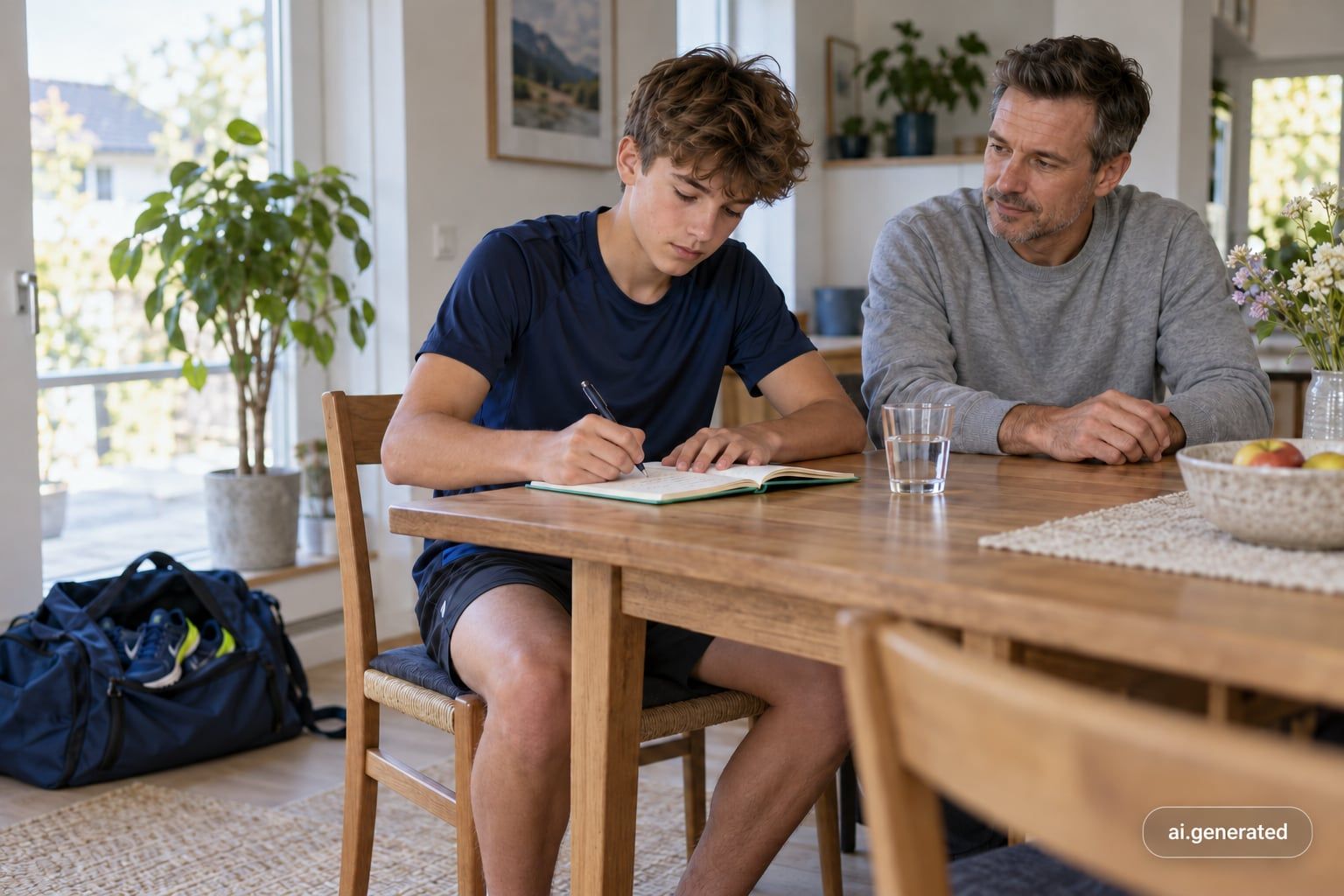
If writing suits your child, they could try three lines later:
- This moment is still on my mind.
- This is what I would like to understand or practise.
- This is the support I would like.
The note belongs to the young person. It does not need to be shown or assessed. Someone who prefers talking, or wants to leave the subject for the day, does not need a written review.
WoosahX offers personalised video sessions for mental preparation. The family research discussed here does not examine the platform’s effectiveness. If you are interested, start with the young athlete’s goals. The WoosahX parent guide provides further information.
Before the next competition, you can agree on which first question is welcome and how your child can tell you they need some space.